
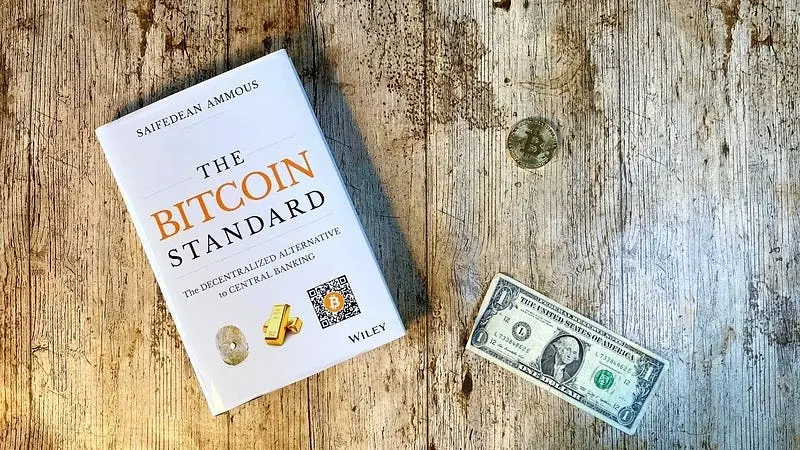
Explore the Saifedean Ammous analysis of the history of money, from barter systems in ancient civilizations to modern fiat currencies, and learn how this understanding sets the stage for Bitcoin’s revolutionary potential.
Introduction
The Bitcoin Standard: The Decentralized Alternative to Central Banking by Saifedean Ammous is a groundbreaking book that delves into the history of money, the evolution of the financial system, and the revolutionary potential of Bitcoin. This book provides a comprehensive analysis of Bitcoin’s underlying technology and its potential impact on the global economic landscape. In this review, we will examine the key themes, arguments, and insights presented in The Bitcoin Standard, highlighting its relevance to both cryptocurrency enthusiasts and the broader public.
Overview
The Bitcoin Standard is divided into two main parts: the first part discusses the history and theory of money, while the second part focuses on the emergence of Bitcoin and its potential implications for the future of finance. Throughout the book, Ammous demonstrates a deep understanding of economic principles, monetary history, and the technical intricacies of Bitcoin. His writing is clear and engaging, making complex concepts accessible to readers of all backgrounds.
Part 1: The History and Theory of Money
In the first part of The Bitcoin Standard, Ammous presents a thorough exploration of the history of money, starting with the emergence of barter systems in ancient civilizations and progressing to the development of modern fiat currencies. He provides a detailed analysis of the characteristics of sound money, emphasizing the importance of scarcity, durability, divisibility, and transferability.
Ammous argues that throughout history, societies have thrived when they adopted hard money - currencies with high stock-to-flow ratios, such as gold and silver. These currencies maintained their value over time and promoted long-term planning and economic growth. Conversely, societies that relied on easy money - currencies with low stock-to-flow ratios that can be easily inflated - experienced economic decline and social unrest.
A key theme in this section of the book is the importance of a sound monetary system for fostering prosperity and social cohesion. Ammous emphasizes that when a currency’s value is eroded through inflation, individuals and businesses are incentivized to pursue short-term gains at the expense of long-term planning and investment. This, in turn, leads to economic stagnation and inequality.
Ammous also discusses the rise of central banking and the adoption of fiat currencies as the global monetary standard. He critiques the current financial system, arguing that it is inherently unstable and susceptible to crises due to its reliance on debt and inflationary monetary policy. This critique sets the stage for the introduction of Bitcoin as a potential alternative to central banking.
Part 2: Bitcoin and the Decentralized Alternative
In the second part of The Bitcoin Standard, Ammous turns his attention to Bitcoin, examining its technical foundations, unique characteristics, and potential to serve as a decentralized alternative to central banking. He begins by providing an overview of Bitcoin’s creation in 2008 by the pseudonymous programmer, Satoshi Nakamoto, and its subsequent development.
Ammous then delves into the key features that make Bitcoin a unique form of money:
- Decentralization: Bitcoin’s blockchain technology enables transactions to be processed and verified without the need for a central authority. This decentralization ensures that no single entity can control the supply of Bitcoin or manipulate its value.
- Scarcity: Bitcoin has a fixed supply of 21 million coins, which ensures that its value cannot be diluted through inflation. This scarcity is enforced by the network’s consensus algorithm, which governs the creation of new coins and the validation of transactions.
- Immutability: Once a transaction is recorded on the Bitcoin blockchain, it cannot be altered or erased. This immutability ensures the integrity of the transaction history and protects against fraud and manipulation.
- Security: Bitcoin’s network is secured through a process called mining, which involves participants solving complex mathematical problems to validate transactions and add new blocks to the blockchain. This process is highly resource-intensive, making it prohibitively expensive for any malicious actor to compromise the network.
- Programmability: Bitcoin’s underlying technology enables the creation of smart contracts and other programmable financial instruments, which have the potential to revolutionize industries beyond finance.
Ammous argues that these characteristics make Bitcoin a superior form of money compared to traditional fiat currencies. He emphasizes that Bitcoin’s decentralization, scarcity, and security offer a compelling alternative to the inflationary and unstable nature of central banking. By providing a form of hard money that is immune to government interference and manipulation, Bitcoin could usher in a new era of economic prosperity and financial autonomy.
Throughout this section of the book, Ammous also addresses common misconceptions and criticisms of Bitcoin, including concerns about its energy consumption, scalability, and the potential for regulatory crackdowns. He offers counterarguments and potential solutions to these challenges, demonstrating a balanced and well-informed perspective on the future of Bitcoin.
Key Insights and Implications
The Bitcoin Standard offers several key insights and implications for readers interested in understanding the revolutionary potential of Bitcoin:
- The importance of sound money: Ammous emphasizes that a sound monetary system is essential for promoting long-term economic growth, social cohesion, and individual freedom. By offering a form of hard money that is resistant to inflation and government control, Bitcoin has the potential to serve as a powerful catalyst for positive change.
- The potential for disintermediation: Bitcoin’s decentralized nature and programmability could enable the development of novel financial instruments and services that bypass traditional intermediaries. This disintermediation has the potential to increase efficiency, reduce costs, and expand access to financial services for individuals and businesses worldwide.
- The need for a new monetary standard: Ammous argues that the current global financial system, based on central banking and fiat currencies, is inherently unstable and unsustainable. He posits that Bitcoin could provide the foundation for a new monetary standard that promotes stability, prosperity, and financial autonomy.
- The potential for geopolitical implications: The widespread adoption of Bitcoin could have significant geopolitical implications, challenging the dominance of major fiat currencies like the US dollar and reshaping global power dynamics. This shift could lead to a more decentralized and multipolar world, with nations competing for influence in the emerging digital economy.
Conclusion
The Bitcoin Standard is a thought-provoking and well-researched book that offers valuable insights into the history of money, the challenges of central banking, and the revolutionary potential of Bitcoin. Saifedean Ammous presents a compelling case for Bitcoin’s ability to serve as a decentralized alternative to central banking, providing a form of hard money that could promote economic growth, social cohesion, and financial autonomy.
This book is an essential read for anyone interested in understanding the transformative potential of Bitcoin and its implications for the future of finance. By offering a comprehensive analysis of Bitcoin’s unique characteristics and addressing common misconceptions and criticisms, Ammous equips readers with the knowledge and perspective needed to navigate the rapidly evolving world of digital currencies.
Whether you are a seasoned Bitcoin enthusiast or new to the world of digital currencies, The Bitcoin Standard will undoubtedly provide you with valuable insights and a deeper appreciation for the revolutionary potential of this emerging technology.
Where to buy it?
You can find it and more Bitcoin books on The Bitcoin Hole site:
Visit our Website
With so many hardware wallets on the market, it can be challenging to choose the right one for your needs. That’s where our Hardware Wallet Comparison TheBitcoinHole.com website comes in. You will find the most comprehensive and honest resource for comparing the features of the top hardware wallets.
Support Us
There are different ways to support our work:
 Support Us on Ko-fi