
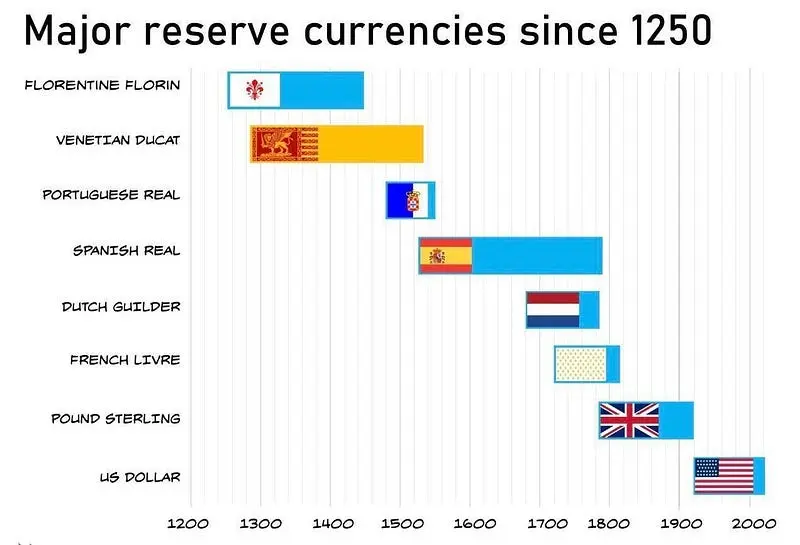
Discovering the Major Reserve Currencies from the Florentine Florin to the US Dollar, and Anticipating the Potential Rise of Bitcoin as the Next Dominant Reserve Currency.
Throughout history, the global economy has been shaped by various dominant reserve currencies. A reserve currency is a widely recognized and stable form of money that countries and institutions use for international transactions and to hold in their foreign exchange reserves. These currencies have played a critical role in facilitating global trade, finance, and geopolitics. This article will take you on a journey through time, exploring the major reserve currencies since 1250, their rise to dominance, and the factors that led to their eventual decline.
Florentine Florin
The Florentine Florin, a gold coin minted in the city-state of Florence (now part of modern-day Italy), emerged as one of the first widely accepted international currencies during the 13th century. Florence was a thriving center of trade and finance, and the Florin was designed to facilitate commerce both within the city and across Europe.
The Florin’s popularity was due to several factors. First, it was made of high-quality gold, with consistent gold content that made it reliable and trustworthy. Second, the coin’s design featured easily recognizable symbols, such as the fleur-de-lis (a stylized lily), which represented Florence. Lastly, the Florin’s wide acceptance across Europe meant that merchants could easily use it for transactions, reducing the need for cumbersome barter arrangements or currency exchanges.
Over time, however, the Florentine Florin’s dominance began to wane as other powerful city-states and nations developed their own currencies and financial systems. This led to a period of transition during which the next major reserve currency would emerge.
Venetian Ducat
As the Florentine Florin’s influence declined, the Venetian Ducat rose to prominence as the dominant reserve currency. Venice, like Florence, was a powerful and wealthy city-state that played a critical role in global trade and finance. The Ducat (also known as the Zecchino) was a gold coin that offered many of the same benefits as the Florin, including consistent gold content and widespread acceptance among merchants and traders.
The Venetian Ducat gained prominence in part due to Venice’s strategic location along major trade routes, which connected Europe with the Middle East and Asia. The city’s powerful navy and extensive trading network helped ensure the Ducat’s widespread use and acceptance. However, the rise of powerful nation-states and the discovery of new trade routes eventually diminished Venice’s prominence, leading to the decline of the Ducat as the leading reserve currency.
Portuguese Real
The Portuguese Real emerged as a significant reserve currency during the Age of Discovery, approximately between 1450 and 1660. Portugal’s pioneering role in global exploration and trade led to the establishment of the first truly global empire, with territories spanning Africa, Asia, and South America. The Portuguese Real became widely accepted across these territories, cementing its role as an important reserve currency of the time.
The Real’s prominence was supported by Portugal’s control of lucrative trade routes, particularly the valuable spice trade from Asia. The Portuguese Empire’s network of trading posts and forts facilitated the exchange of goods and the spread of the Real, making it a key currency for international commerce.
However, the decline of the Portuguese Empire and the rise of other European powers, such as the Dutch Republic and Great Britain, led to the eventual displacement of the Portuguese Real as a major reserve currency.
Spanish Real de a Ocho
The 16th century marked the rise of Spain as a global superpower, and with it, the emergence of the Spanish Real de a Ocho (also known as the Spanish Dollar or Piece of Eight) as the dominant reserve currency. The Real de a Ocho was a silver coin that became widely accepted in Europe, the Americas, and Asia, primarily due to Spain’s vast empire, which spanned several continents.
Several factors contributed to the Real de a Ocho’s popularity as a reserve currency. First, the coin’s silver content was consistent and reliable, making it a trusted medium of exchange. Second, the Spanish empire’s global reach meant that the Real de a Ocho was widely accepted and circulated throughout the world. Lastly, the coin was divisible into smaller denominations (such as the Spanish real), which made it a practical currency for a variety of transactions.
However, the Spanish empire’s decline, coupled with economic challenges and the rise of other global powers, eventually led to the Real de a Ocho’s fall from prominence.
Dutch Guilder
The Dutch Guilder emerged as the dominant reserve currency in the 17th century, coinciding with the Dutch Golden Age, a period during which the Netherlands became a global economic and financial powerhouse. The Dutch Guilder was a silver coin that benefited from the Netherlands’ economic success, innovative financial systems, and extensive trading network.
The Dutch Guilder’s rise to prominence was fueled by several factors. The Dutch East India Company, one of the first multinational corporations, played a significant role in promoting the use of the Guilder across its vast trading network. Additionally, the Amsterdam Stock Exchange, the world’s first stock exchange, facilitated international trade and investment using the Guilder. Finally, the Dutch Republic’s political stability and economic prowess contributed to the currency’s widespread acceptance and trust.
However, the decline of the Dutch Golden Age and the rise of other global powers, such as Great Britain, eventually led to the Dutch Guilder losing its status as the world’s primary reserve currency.
British Pound Sterling
In the early 18th century, the UK introduced the gold standard, tying the value of the pound to a specific amount of gold. This helped stabilize the currency and facilitated international trade, as other countries also adopted the gold standard. The pound sterling became the world’s leading reserve currency during the 19th century, reflecting the UK’s economic and political power during the Industrial Revolution and the expansion of the British Empire.
The Pound Sterling’s popularity was due in part to the strength of the British economy and the nation’s innovative financial institutions, such as the Bank of England, which was established in 1694. The Pound was a reliable and widely accepted currency, facilitating international trade and investment throughout the British Empire and beyond.
However, the devastation of two World Wars and the decline of the British Empire in the 20th century led to the Pound Sterling’s eventual displacement as the world’s leading reserve currency.
US Dollar
The US Dollar emerged as the world’s primary reserve currency after World War II, with the establishment of the Bretton Woods system in 1944. This system pegged major currencies to the US Dollar, which was in turn convertible to gold at a fixed rate. The United States’ economic strength and political stability positioned the US Dollar as the ideal reserve currency for the post-war era.
The US Dollar’s dominance as a reserve currency has been reinforced by several factors, including the size and strength of the US economy, the global acceptance of the Dollar for trade and investment, and the currency’s role as a safe-haven asset during times of economic uncertainty.
Bitcoin: The Future Dominant Reserve Currency?
As technology continues to advance, the world is increasingly shifting towards digital and decentralized solutions for various aspects of life, including finance. Bitcoin has emerged as a potential contender for the role of a global reserve currency.
Since its creation in 2009, Bitcoin has experienced significant growth in value and adoption, and its market capitalization is now measured in trillions of dollars. Its decentralized nature, limited supply, and resistance to censorship make it an attractive alternative to traditional reserve currencies.
Central banks and governments around the world are taking note of the growing importance of Bitcoin. El Salvador made Bitcoin legal tender in 2021 and, although it amended the law in 2025 to make acceptance voluntary for merchants, it keeps adding Bitcoin to its national reserves, demonstrating the potential for greater acceptance and adoption in the future.
If Bitcoin continues to gain mainstream acceptance and adoption, it could eventually challenge the dominance of traditional reserve currencies like the US Dollar.
In conclusion, the history of major reserve currencies has been marked by a continuous cycle of rise and fall, driven by various factors such as economic strength, political stability, and technological advancements. As the world becomes more interconnected and digital, Bitcoin may emerge as the next dominant reserve currency, reshaping the landscape of global finance. However, only time will tell if this bold prediction comes to fruition.
Visit our Website
With so many hardware wallets on the market, it can be challenging to choose the right one for your needs. That’s where our Hardware Wallet Comparison TheBitcoinHole.com website comes in. You will find the most comprehensive and honest resource for comparing the features of the top hardware wallets.
Support Us
There are different ways to support our work:
 Support Us on Ko-fi